On Wednesday, the tablet wars began. Up to then, all talk of a "tablet market" was misleading: it was essentially an iPad market.
Having launched in April 2010 a device for which most people thought there was no definable niche, Apple then proceeded to sell upwards of 30 million of these insanely expensive consumer products, on which it was reportedly making a 40% margin.
There were other tablets, most of which, with one notable exception – the Samsung Galaxy Tab – were turkeys. But until Wednesday, nothing had appeared that looked like being able to make a dent in Apple's licence to print money.
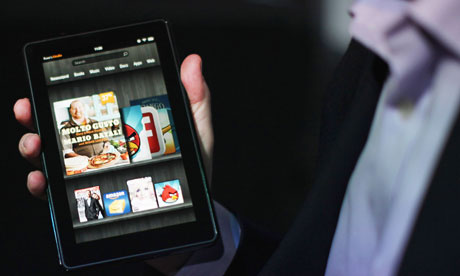
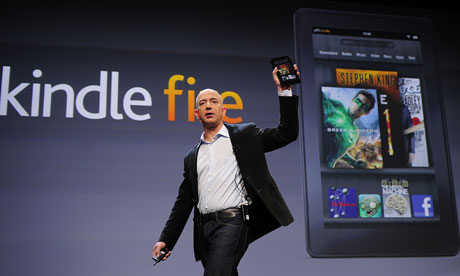
The challenger emerged from the expected source: Amazon. On Wednesday, Jeff Bezos, the company's charismatic founder, unveiled the Kindle Fire, its first venture into the tablet market.
At this point, non-technical readers, clutching their beloved Kindles, may object that Amazon has been in the tablet market ever since the Kindle launched in 2007. But the Kindle is not really a tablet computer in any meaningful sense – it's an information appliance that fulfils one function well: fetching and displaying ebooks.
The Fire is different. It has a colour touch screen and can play video, for example. More significantly, it can run apps, has a proper operating system (a customised version of Google's Android) and does wireless networking. And it comes with its own, custom-designed web browser, called Silk (of which more in a moment). Oh, and at $199 it's less than half the price of a basic iPad2, which may, in the end, turn out to be the most important thing about it.
The Fire doesn't go on sale in the US until 19 November and so we will have to wait for the tech vultures who disassemble new kit to do their stuff before we know what its bill of materials actually comes to.
But my guess is that Amazon will be selling it at a loss, just as it did with the first Kindle. And that highlights the difference between it and Apple. Amazon makes its money from content – sales of books, music, videos – and uses the Kindle as a way of enabling "frictionless purchasing" of that content. Apple, in contrast, makes most of its money from selling beautiful kit with outrageous profit margins. It also sells content – think of the iTunes store – but the margins on that are significantly less than on the hardware.
Which is why the tablet wars have just begun. Amazon is just about the only outfit around that can give Apple a run for its money. It has vast amounts of content instantly available in its internet "cloud" and a purchasing and order-fulfilment system at least as slick as Apple's. If it turns out that the Fire tablet is really as good as Amazon hopes at encouraging people to consume digital content, then it can continue to sell the Fire at below cost, challenging Apple to reduce the price of the iPad and thereby erode its margins.
The prospect of the forthcoming battle between these two technology giants has led some excitable analysts to declare that, whichever company triumphs, "the consumer is going to be the winner". Oh yeah? The reality is that both Apple and Amazon are aiming at the same thing: locking in the consumer to their system. Apple has done this via the iTunes and App Store, which ensures that nothing runs on an Apple iDevice that hasn't been approved by the company. Amazon's approach is only slightly more subtle. The Fire comes with only 8GB of memory, which means that most of the content that its users will access will come from Amazon's Cloud storage. In that sense, the Fire is the ultimate network appliance.
But there's an added twist. The Fire also comes with a pretty slick browser that loads pages faster than even browsers running on fast PCs. So 100 millisecond (ms) load times are reportedly reduced to 5ms. This is achieved by having the processing done not by the Fire but by remote virtual machines running in Amazon's EC2 Cloud, and by clever caching and pre-emptive fetching of links. "This means," writes Jason Calacanis, a well-known internet entrepreneur, "if you're on the NYTimes.com they have, in their cloud and possibly already on your device, the next five pages you're going to click on. They know this because the last five folks to hit the NYTimes.com's homepage opened those pages. These kind of caching services have a ton of privacy implications, as they are now sitting between you and your favourite porn site… I mean political activism site! Not only do they have an entire history of which URLs folks are downloading, they have the actual download."
The phrase "all fired up" is about to acquire a whole new meaning.
Having launched in April 2010 a device for which most people thought there was no definable niche, Apple then proceeded to sell upwards of 30 million of these insanely expensive consumer products, on which it was reportedly making a 40% margin.
There were other tablets, most of which, with one notable exception – the Samsung Galaxy Tab – were turkeys. But until Wednesday, nothing had appeared that looked like being able to make a dent in Apple's licence to print money.
The challenger emerged from the expected source: Amazon. On Wednesday, Jeff Bezos, the company's charismatic founder, unveiled the Kindle Fire, its first venture into the tablet market.
At this point, non-technical readers, clutching their beloved Kindles, may object that Amazon has been in the tablet market ever since the Kindle launched in 2007. But the Kindle is not really a tablet computer in any meaningful sense – it's an information appliance that fulfils one function well: fetching and displaying ebooks.
The Fire is different. It has a colour touch screen and can play video, for example. More significantly, it can run apps, has a proper operating system (a customised version of Google's Android) and does wireless networking. And it comes with its own, custom-designed web browser, called Silk (of which more in a moment). Oh, and at $199 it's less than half the price of a basic iPad2, which may, in the end, turn out to be the most important thing about it.
The Fire doesn't go on sale in the US until 19 November and so we will have to wait for the tech vultures who disassemble new kit to do their stuff before we know what its bill of materials actually comes to.
But my guess is that Amazon will be selling it at a loss, just as it did with the first Kindle. And that highlights the difference between it and Apple. Amazon makes its money from content – sales of books, music, videos – and uses the Kindle as a way of enabling "frictionless purchasing" of that content. Apple, in contrast, makes most of its money from selling beautiful kit with outrageous profit margins. It also sells content – think of the iTunes store – but the margins on that are significantly less than on the hardware.
Which is why the tablet wars have just begun. Amazon is just about the only outfit around that can give Apple a run for its money. It has vast amounts of content instantly available in its internet "cloud" and a purchasing and order-fulfilment system at least as slick as Apple's. If it turns out that the Fire tablet is really as good as Amazon hopes at encouraging people to consume digital content, then it can continue to sell the Fire at below cost, challenging Apple to reduce the price of the iPad and thereby erode its margins.
The prospect of the forthcoming battle between these two technology giants has led some excitable analysts to declare that, whichever company triumphs, "the consumer is going to be the winner". Oh yeah? The reality is that both Apple and Amazon are aiming at the same thing: locking in the consumer to their system. Apple has done this via the iTunes and App Store, which ensures that nothing runs on an Apple iDevice that hasn't been approved by the company. Amazon's approach is only slightly more subtle. The Fire comes with only 8GB of memory, which means that most of the content that its users will access will come from Amazon's Cloud storage. In that sense, the Fire is the ultimate network appliance.
But there's an added twist. The Fire also comes with a pretty slick browser that loads pages faster than even browsers running on fast PCs. So 100 millisecond (ms) load times are reportedly reduced to 5ms. This is achieved by having the processing done not by the Fire but by remote virtual machines running in Amazon's EC2 Cloud, and by clever caching and pre-emptive fetching of links. "This means," writes Jason Calacanis, a well-known internet entrepreneur, "if you're on the NYTimes.com they have, in their cloud and possibly already on your device, the next five pages you're going to click on. They know this because the last five folks to hit the NYTimes.com's homepage opened those pages. These kind of caching services have a ton of privacy implications, as they are now sitting between you and your favourite porn site… I mean political activism site! Not only do they have an entire history of which URLs folks are downloading, they have the actual download."
The phrase "all fired up" is about to acquire a whole new meaning.