Pages

Showing posts with label Apple's. Show all posts

Monday, October 31, 2011

Steve's bio: a personal perspective

The arc of Steve Jobs's life is the stuff of legends, but his new biography forces us to stare at the realities of the actual man

Let me jump to the conclusion: This is an extraordinary book on many levels. It's informative, entertaining often, insightful, sympathetic but not indulgent; it rises to its unusual subject and manages to render its complexity in a straightforward manner that attests to the biographer's talent.
  1. Steve Jobs: The Exclusive Biography
  2. by Walter Isaacson
  3. Buy it from the Guardian bookshop
  1. Tell us what you think: Star-rate and review this book
Get thee to a physical bookstore, if you can find one, or to Amazon's or Apple's online dispensers – you won't regret it. And if you don't have the time or patience, start with Chapter 36: The iPhone, Revolutionary Products in One (page 465 on paper, easily searched on electrons).
Last year, Walt Isaacson called to talk about the bio Steve had asked him to write. No surprise there – Dear Leader always wanted the best, and Isaacson had written world-class biographies of Ben Franklin, Einstein and Henry Kissinger.
I told Isaacson how sad this felt, how I perceived Steve's decision as ''putting his affairs in order'' before leaving this Earth. Walt didn't answer directly, but he did say something shocking: Steve had relinquished all control over the book; all decisions were Walt's.
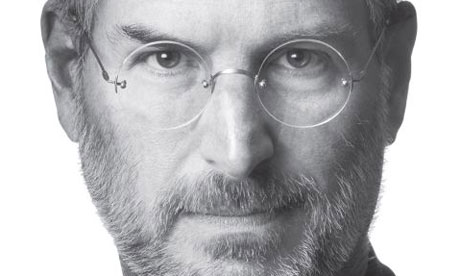
I didn't believe it. I couldn't see Steve giving up control on anything. His fanatical attention to detail is, sorry, was a key ingredient of his success. But Steve's editorial grip on the book went no further than his picture on the cover. In Isaacson's words:
He had never, in two years, asked anything about what I was putting in the book or what conclusions I had drawn. But now he looked at me and said, "I know there will be a lot in your book I won't like." It was more a question than a statement, and when he stared at me for a response, I nodded, smiled and said I was sure that would be true. "That's good," he said. "Then it won't seem like an in-house book. I won't read it for a while, because I don't want to get mad. Maybe I will read it in a year – if I'm still around." By then, his eyes were closed and his energy gone, so I quietly took my leave.
To be sure, this isn't your typical CEO encomium where the slightest achievements are remembered as world-changing deeds, and unseemly details are airbrushed into endearing idiosyncrasies.
The arc of Steve's life is the stuff of legends: abandoned at birth; raised in Silicon Valley; an acid-dropping, ashram-dwelling college drop-out, hacker, and co-founder of the most iconic of personal computer companies; fired at age 30; re-inventor of animated movies at Pixar; the struggle to create the NeXT big thing; the return to Apple in the most stunning turnaround the industry had ever seen; reshaping the music industry; building a world-class retail network in his own image; re-inventing the smartphone industry and grabbing half of its profits; and, finally, after 30 years of false starts, making tablets a reality and grabbing iPod-like market and profit share as a result. An arc that saw the unmanageable hippie become the head of one of the world's best-managed companies. And he died just as he reached the pinnacle.
This could tempt both subject and his biographer to produce a statuesque book, a North Korean monument to Dear Leader's achievements. But instead of The Life and Miracles of Saint Steve, we get the gift of truth. We are forced to stare at the reality, or realities of the actual man. Thinking of his children, for whom Steve said the book was, so they got to better know him, this book is a great present. Judging oneself only by comparison to the better side of a parent is a terrible burden. Walt's book gives them an independent look into the incredibly luminous Steve as well as into his sometimes repulsive dark side. Steve's must have hoped to free them from his legend.
On the one hand, Isaacson shows the man who thrilled us with his (almost) unerring taste, with his sense that computers of various sizes and forms were more than merely utilitarian, that they were the objects, the vehicles of an evolving culture. Visionary, artist, leader, innovator … the list of meliorative words goes on, and rightly so: Steve was all these.
On the other hand, Isaacson manages the feat of being, by turns, empathetic, even affectionate and, in the next sentence, unblinkingly factual. The book will confirm everything you've heard about Steve's unpleasant sides, and then some. When learning of his truly pathological eating habits, for example, you'll wonder about his sanity. I don't use the word pathological lightly: you'll see how delusional Steve was when, for eight months, he refused surgery for his diagnosed pancreatic cancer, choosing instead a strict vegan diet, acupuncture and "herbal remedies, and occasionally a few other treatments he found on the internet or by consulting people around the country, including a psychic".
In a similar vein, you'll read what Jony Ive, Apple's senior vice-president of design, Steve's soulmate, had to say about his dark side:
… his way to achieve catharsis is to hurt somebody. And I think he feels he has a liberty and a license to do that. The normal rules of social engagement, he feels, don't apply to him. Because of how very sensitive he is, he knows exactly how to efficiently and effectively hurt someone.
Yes, that's also the way Steve was. With everyone, family included.
Knowing or having known many of the characters in the book, I can vouch for its accuracy. But, even more important, I can vouch for its voice. Walt Isaacson got Steve right. He didn't get intimidated, he wasn't seduced into being a groupie, he didn't get nauseated or angry. Instead, he delivered the truest rendition I've read of one of the most complicated people I've known.
His subject's complexity didn't rob Isaacson of his dry wit, such as this observation when observing Jobs after his liver transplant:
As Jobs got better, much of his feisty personality returned. He still had his bile ducts.
Or from recording memorable Bill Gates quotes such a this one:
I've been predicting a tablet with a stylus for many years," he told me. "I will eventually turn out to be right or be dead.
(Not so fast, Bill, we love to have you and Ballmer around.)
In my view, the only way to keep one's sanity when dealing with Steve was to stay ambivalent, to force oneself to harbour contradictory feelings about him. Easier said than done. In my case, over time, feelings of admiration and affection have taken over when watching the feats and the struggle. Reading Walt's book was a helpful and, at times, painful reminder of who Jobs actually was.
JLG@mondaynote.com

source

Tuesday, October 18, 2011

Mango shows Microsoft still has the taste for smartphone success

The only worry is that Microsoft has delivered this lovely Windows operating system a little too late

Steve Jobs famously criticised Microsoft for having no taste and no culture. Windows Phone 7.5, the latest version of Microsoft's operating system for mobile phones, is a revolutionary product for its parent company because it has both in spades. The worry is that Microsoft has delivered this lovely creation a little too late.
As a piece of visual design, the operating system also known as Mango makes the iPhone's bubble-inspired home screen graphics look tired and out of date. The style is pared back, letting the content, drawn in from the myriad of online sources that now figure in our daily lives, do the talking. Applications each inhabit a simple red square, or "live tile" on a black screen. When customised they earn their name and truly come to life, which is where the culture comes in.
The level to which a select group of the best social media platforms – Facebook, Twitter, LinkedIn – have been woven into the functions on Mango goes well beyond what was available on its predecessor (Windows Phone 7), and arguably well beyond what Apple's iPhone and Google's Android can offer.
Punch in your Facebook and Twitter coordinates, and the software merges them with your address book to create a profile for each contact, with their latest photos, status updates and tweets. Pin that person's tile to your home screen, and each update feeds into the little square.
The most recent photos taken on your phone are also displayed in their own double sized tile. And the home screen can, unlike many other operating systems, display multiple tiles from a single application – one for each item you are bidding for on Ebay, or the weather in a handful of cities.
The messaging has caught up with iPhone. A conversation that might begin on Facebook chat but then moves to text messaging or Windows Live Messenger – the Microsoft instant messaging service – now appears on screen in a single thread.
Where the operating system does fail to impress is with voice recognition. Mango incorporates it, for example to compose an email. But "Want you meet camera" is not a very usable approximation of "Want to meet tomorrow".
Voice commands are not just a diverting new trick. They are the future for smartphones. Using virtual keypads on a tiny touch screen is life sapping, and impossible to do while walking. But the trusty buttons of a qwerty keyboard are just not sexy enough to be added to the iPhone. So Apple is doing its level best to get us using Siri, its own voice service, which has surprised users with its accuracy. Microsoft has some catching up to do here.
And it will make every effort to catch up. The software behemoth is not just fighting for a nice sideline, it is fighting for control of the mass market computer. As mobile connected devices become cleverer and are touched by millions more fingers than have ever typed on a PC keyboard, the importance of the laptop or desktop computer will fade and with it Microsoft's influence.
There is a long battle ahead. Research firm IDC says Windows operating systems were on just 2% of phones sold worldwide in the first half of this year, down from 13% in 2008. Back then, Android's share was 0%. In three years it has become the best seller, with 42%. BlackBerry is still significant, and Apple's iOS is at 19%.
The first Nokia handsets to use Windows will be unveiled in London next week. Nokia still sells more "feature" phones than anyone else, but it sold just 15% of smartphones in the summer, down from 33% in 2010. Its decision to abandon Symbian left it unable to compete for most of this year. The alliance with Microsoft is clearly make or break, and their target as they attempt to rise up the ranks will be Android.
Research In Motion, maker of BlackBerry, will continue to chase its corporate market. Apple will remain the premium brand for now. Which will leave Microsoft and Google slugging it out for dominance of the cheaper, mass market handsets.
Where Google may have the edge is control over handset design. It is buying Motorola, possibly just for the patents needed to protect Android against litigation, or possibly to create better phones. Nokia and Microsoft are merely in an alliance, but they have size, marketing firepower, relationships with networks and experience on their side. Nokia won its battle for dominance of the mass market against Motorola at the end of the 1990s, and still sells more basic feature phones than anyone else. Microsoft knows a lot more about selling operating systems than Google, albeit on PCs. Its creator may be a fading force, but Mango shows Microsoft still has the taste for success.

source

Monday, October 17, 2011

Steve Jobs honoured by Silicon Valley

Executives gather at Stanford University to celebrate life of Apple founder, who died of pancreatic cancer recently

Some of Silicon Valley's top executives were set to gather at Stanford university on Sunday evening to celebrate the life and genius of the Apple founder Steve Jobs.
Fittingly perhaps for a memorial of a man who was notoriously secretive, the precise location of the event and its guest list is under wraps. It is being billed as strictly private, with no public or media coverage welcome.
Last week Jobs had a small private funeral following his death on 5 October, aged 56, from pancreatic cancer. On Wednesday morning, another private event will be held at Apple's Cupertino headquarters for the company's employees to pay their respects to their deceased leader.
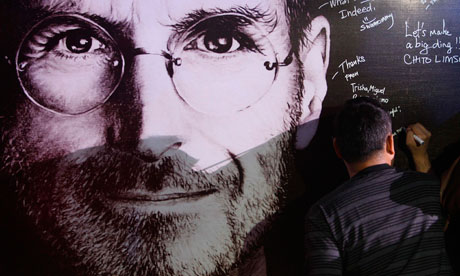
Despite the primarily private nature of the commemorations, Jobs's many admirers and fans have been able to express their sentiments through an outpouring of messages and cards to Apple stores and the company's website.
In California, the governor Jerry Brown declared Saturday "Steve Jobs Day". In a proclamation, he said: "It is fitting that we mark this day to honour his life and achievements as a uniquely Californian visionary. He epitomised the spirit of a state that an eager world watches to see what will come next."
Security around the Stanford commemoration has been so tight that scarcely any details have yet emerged. Reuters reported that the president of one of Apple's bitterest rivals, Samsung Electronics, Lee Jae-yong, would be among the attendants.
Samsung and Apple are fighting for supremacy in the smartphone and tablet markets.

source

Friday, October 14, 2011

iPhone 4S buyers: if there wasn't an iPhone, we'd get a ... BlackBerry

Survey outside London's Regent Street store shows would-be buyers aren't that displeased by RIM's problems

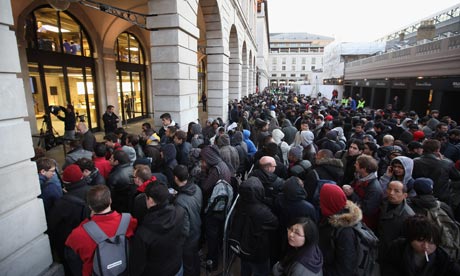
Here's some cause for celebration at the headquarters of BlackBerry maker Research In Motion, which suffered its worst-ever outage this week: if there had never been an iPhone, a third of the people who today bought Apple's new iPhone 4S at its Regent Street store in London say they would have bought a BlackBerry instead.
But RIM can't rest easy: 52% of those queried said they would have bought an HTC, Samsung or Sony Ericsson phone – all of which run Google's Android operating system. Nokia, which is in a battle with Samsung for the title of the world's biggest seller of handsets, only won the approval of 11%.
However the iPhone 4S definitely does exist – and data collected by ProtectYourBubble.com, an insurance company, shows that it is drawing in both new users (35% of those buying were new to Apple's platform) and people upgrading from the iPhone 4 (44%). It surveyed 100 people in the queue for the new phone on Friday morning.
The most popular feature cited by people exiting the store with their new devices, and highlighted by Apple in its presentation of the 4S last week, is the 8MP camera, which makes it comparable with some of the best mobile phone cameras (although some such as the Nokia N8 boast a 12MP setting).
The next most cited was the Siri voice assistant – although early users have discovered that much of its functionality, including maps and restaurants, is not yet working outside the US. Apple has not given any timetable to implement that.
Half of those queueing said they were there because they had missed out on pre-orders through their mobile networks.
And 45% think that the iPhone will go down as the late Steve Jobs's greatest invention – well ahead of the Macintosh (20%), iPod (18%) or iPad (11%).
There's also clear worries about the safety of the phone: while 65% don't have their present phone insured, just over half (56%) say they will for their new one.

source

Thursday, October 13, 2011

Australia court bans Samsung from selling Galaxy tablet

Temporary injunction granted until South Korean electronics company resolves legal dispute with Apple

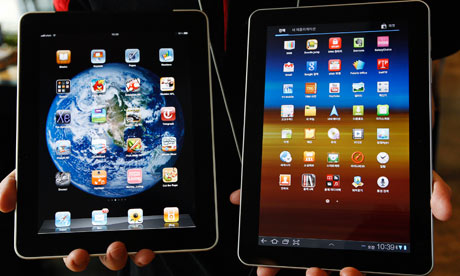
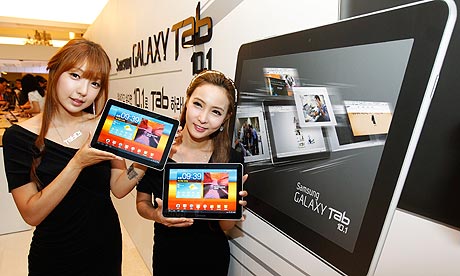
An Australian court has temporarily banned Samsung from selling its new Galaxy tablet computer in the country, another setback for the South Korean electronics company in a global patent battle with Apple that accuses it of slavishly copying the iPad and iPhone.
Federal court justice Annabelle Bennett granted a temporary injunction on Thursday against sales of Samsung's Galaxy Tab 10.1 in Australia. The decision prevents Samsung Electronics Co from selling the device in Australia in its current form until a further court order, or until a pending patent lawsuit between the warring technology giants is resolved.
The ruling is a blow for Samsung, which had hoped to launch the new product in time for Christmas sales. It comes after courts in other countries including Germany and the Netherlands made judgments that upheld Apple's claims that its intellectual property had been appropriated by Samsung.
The patent battle spanning 10 countries has underlined the perception of Samsung as an efficient imitator among technology companies rather than a pace-setter. Over the years, the company has grown to become the global No 1 in TVs and No 2 in smartphones by sales. But unlike Apple it has not mesmerised consumers with its originality and innovation.
In April, California-based Apple sued Samsung in the US, alleging the product design, user interface and packaging of Samsung's Galaxy devices "slavishly copy" the iPhone and iPad.
South Korea-based Samsung Electronics Co. fought back with lawsuits of its own, accusing Apple of patent infringement of its wireless telecommunications technology.
Apple filed the Australian lawsuit in July, accusing Samsung of copying its touch-screen technology. In her ruling on Thursday, Bennett said she was granting the temporary injunction in part because she felt Apple had a sufficient likelihood of winning the trial against Samsung.
The judge's full orders will not be published until Friday. It was not immediately clear whether Samsung could – or would – attempt to sell a variation of the device that removed the features Apple objected to in the Australian lawsuit.
"We are disappointed with this ruling and Samsung will be seeking legal advice on its options," Samsung said in a statement. "Samsung will continue its legal proceeding against Apple's claim in order to ensure our innovative products remain available to consumers."
Samsung, which filed its Australian countersuit in September, said it remained confident it could prove Apple violated its wireless technology patents.
"We will continue to legally assert our intellectual property rights against those who violate Samsung's patents and free ride on our technology," the company said in a statement.
A lawyer for Apple declined to comment after the hearing.

source

Apple wins court ruling to block Samsung Galaxy tablet in Australia

Latest round in global battle over intellectual property goes to US company as judge grants preliminary injunction

An Australian court has temporarily banned Samsung from selling its new Galaxy tablet computer in the country, another setback for the South Korean electronics giant in a global patent battle with Apple, which accuses it of slavishly copying the iPad and iPhone.
Federal Court Justice Annabelle Bennett on Thursday granted a temporary injunction against sales of Samsung's Galaxy Tab 10.1 in Australia. The decision prevents Samsung Electronics Co. from selling the device in Australia in its current form until a further court order, or until a pending patent lawsuit between the warring technology giants is resolved.
The ruling is a blow for Samsung, which had hoped to launch the new product in time for Christmas sales. It comes after courts in other countries including Germany and the Netherlands made judgments that upheld Apple's claims that its intellectual property had been appropriated by Samsung.
Samsung has hit back with threats to ban sales of the new iPhone 4S in France and Germany on the basis that it infringes patents that it holds on certain mobile technologies.
The patent battle spanning 10 countries has created a perception of Samsung as an efficient imitator among technology companies rather than a pacesetter. Over the years, the company has grown to become the global No. 1 in TVs and No. 2 in smartphones by sales. But unlike arch-rival Apple, it has not mesmerised most consumers with its originality and innovation.
It emerged recently that during 2010, Steve Jobs, then Apple's chief executive, tried to broker a deal between the two companies. Samsung is a major supplier of components to Apple, and Apple is one of Samsung's biggest customers, besides their rivalry in devices.
The attempt failed and in April 2011, Apple, based in Cupertino, California, sued Samsung in the United States, alleging the product design, user interface and packaging of Samsung's Galaxy devices "slavishly copy" the iPhone and iPad.
Samsung, from Suwon in South Korea, fought back with lawsuits of its own, accusing Apple of patent infringement of its wireless telecommunications technology.
Apple filed the Australian lawsuit in July, accusing Samsung of copying its touch screen technology. In her ruling Thursday, Bennett said she was granting the temporary injunction in part because she felt Apple had a sufficient likelihood of winning the trial against Samsung.
The judge's full orders will not be published until Friday. It was not immediately clear whether Samsung could or would attempt to sell a variation of the device that removed the features Apple objected to in the Australian lawsuit.
"We are disappointed with this ruling and Samsung will be seeking legal advice on its options," Samsung said in a statement. "Samsung will continue its legal proceeding against Apple's claim in order to ensure our innovative products remain available to consumers."
Samsung, which filed its Australian countersuit in September, said it remained confident it could prove Apple violated its wireless technology patents.
"We will continue to legally assert our intellectual property rights against those who violate Samsung's patents and free ride on our technology," the company said in a statement.
An attorney for Apple declined to comment after the hearing.

source

Thursday, October 6, 2011

Apple's top 10 products

Steve Jobs's legacy includes groundbreaking computing and technology products from the Apple II to the iPhone. Here are 10 of the best

Apple II

Handbuilt by Steve Wozniak – the bearded sidekick to Steve Jobs – the Apple II was released in 1977, just 12 months after the very first Apple computer, the Apple I. Unlike that Apple I, which was assembled in Jobs's parents' garage, the Apple II signalled the Apple co-founder's early drive. Some years later, he was reported as saying: "My dream for the Apple II was to sell the first real packed computer." The Apple II duly became the fastest-selling personal computer of its time, fetching $79m in sales in 1979.

The first Macintosh

The Macintosh 128K was released in January 1984 "with all the showbiz of a car launch". And what a launch it was. No technology company would have dared dream about flaunting a personal computer in a multimillion-dollar Superbowl slot, but Apple did. The Macintosh 128J was different thought – it wasn't especially for business or bespectacled engineers; it was comparatively easy to use.

The iMac

Three years after his return to Apple in 1998, Jobs urged the world to "think different". But no one anticipated the iMac, the computer that kickstarted Apple's fortunes and propelled the company to where it is today. As the Guardian review from 14 May 1998 noted: "nobody who attended last week's product launch expected to find the most radical Macintosh since the original hit the streets 14 years ago … There isn't even a floppy drive."

The iPod

Unveiled a decade ago this month, the iPod is the one device that transformed Apple from a computer company into a mass-market electronics giant – and would later spark a revolution in digital music. Though many who bought it had to hack their computers to store music on it, the first-generation iPod was a stylish MP3 player boasting a 10-hour battery life and space for 1,000 songs. "Listening to music will never be the same again," said Jobs at its launch in October 2001.

The iPod nano

Steve Jobs discontinued the iPod mini at the height of its popularity in September 2005. His indefatigable drive for design and efficiency saw it replaced with the much smaller nano. Apple reinvented the nano in September 2010 with its sixth iteration. At 21.1g the new nano was 15g lighter than its predecessor and half the height.

The iPhone

Less than half a decade after the iPod, Apple was already the biggest name in digital music. After months of rumour and anticipation, Jobs, in January 2007, unveiled what would quickly become Apple's killer product. The phone was a hit with techies and non-techies alike. A typically fervent Stephen Fry reviewed the iPhone four months after its launch. "Beauty. Charm. Delight. Excitement. Ooh. Aah. Wow! Let me at it," he wrote in the Guardian. With the fifth incarnation unveiled earlier this week, the excitement has not yet dissipated.

iTunes

Until Jobs unveiled iTunes in January 2001, no one had been able to convince music label executives that people might pay for songs online. Announced at the back end of a 90-minute keynote to launch the new Macintosh, iTunes was an unexciting "all-in-one digital music program" that brought together MP3 playback, internet radio and CD writing. This week Apple began letting people access their digital music across any of their devices wirelessly. It is the beginning of Apple's cloud revolution.

The iPad

Apple's so-called "Jesus tablet" was everything that everyone didn't need on its launch in January 2010. Less than a year later, Apple had invented a new market and intentionally spawned hundreds of poor-man copycats. Dubbed "the oversized iPhone" with a 9.7in screen, Apple's lean-back device would be the saviour of the media industry. Research group Gartner last month forecast that tablet computers will see an explosion in sales over the next four years, selling 60% as many units as PCs by 2015 – and Apple's iPad will still have almost half the market by then.

iOS App Store

Apple announced a new milestone for its App Store in July this year: 15bn downloads (of more than 500,000 apps) since it launched in July 2008. The App Store has become the cornerstone to the iPhone's success, with the world's media giants all scrambling for a prominent place on the smartphone of choice – and spawning a new market for software developers. Pundits called it the future of mobile consumption, and Apple has since expanded its App Store to OS X computers, potentially ushering in a new age of software development.

One more thing: Apple stores

Apple opened its first retail store on 19 May 2001, in Glendale, California. As of July this year, Apple had opened more than 350 stores worldwide, with the largest in London's Covent Garden. Most thought Apple's move into physical retail space was madness – but they did not foresee that the philosophy, design and layout of the stores would encapsulate what drives Jobs. Customers have since flocked to the Genius Bar.

source


Wednesday, October 5, 2011

Steve Jobs quotes: the man in his own words

Steve Jobs, Apple co-founder, has died. Here are his thoughts on everything from design to the internet and death itself

Steve Jobs, Apple co-founder and technological visionary, was well known for his words as well as his creations. Here are some of his thoughts over the past 25 years.

On life

"Remembering that I'll be dead soon is the most important tool I've ever encountered to help me make the big choices in life. Because almost everything - all external expectations, all pride, all fear of embarrassment or failure - these things just fall away in the face of death, leaving only what is truly important. Remembering that you are going to die is the best way I know to avoid the trap of thinking you have something to lose. You are already naked. There is no reason not to follow your heart."
– Stanford commencement speech 2005

On Macintosh

"I don't think I've ever worked so hard on something, but working on Macintosh was the neatest experience of my life. Almost everyone who worked on it will say that. None of us wanted to release it at the end. It was as though we knew that once it was out of our hands, it wouldn't be ours any more.
"When we finally presented it at the shareholders' meeting, everyone in the auditorium stood up and gave it a 5-minute ovation. What was incredible to me was that I could see the Mac team in the first few rows. It was as though none of us could believe that we'd actually finished it. Everyone started crying."
– Playboy magazine 1985

On customers

"There's nothing that makes my day more than getting an e-mail from some random person in the universe who just bought an iPad over in the UK and tells me the story about how it's the coolest product they've ever brought home in their lives. That's what keeps me going. It's what kept me five years ago [when he was diagnosed with cancer], it's what kept me going 10 years ago when the doors were almost closed. And it's what will keep me going five years from now whatever happens."
- AllThingsD Conference, 2010

On technology

"We think the Mac will sell zillions, but we didn't build the Mac for anybody else. We built it for ourselves. We were the group of people who were going to judge whether it was great or not. We weren't going to go out and do market research. We just wanted to build the best thing we could build.
When you're a carpenter making a beautiful chest of drawers, you're not going to use a piece of plywood on the back, even though it faces the wall and nobody will ever see it. You'll know it's there, so you're going to use a beautiful piece of wood on the back. For you to sleep well at night, the aesthetic, the quality, has to be carried all the way through."
– Playboy magazine 1985

On motivation

"That's been one of my mantras — focus and simplicity. Simple can be harder than complex: You have to work hard to get your thinking clean to make it simple. But it's worth it in the end because once you get there, you can move mountains."
– Business Week 1998

On money

"Being the richest man in the cemetery doesn't matter to me … Going to bed at night saying we've done something wonderful … that's what matters to me."
– Wall Street Journal 1993

On internet start-ups

"The problem with the internet start-up craze isn't that too many people are starting companies; it's that too many people aren't sticking with it. That's somewhat understandable, because there are many moments that are filled with despair and agony, when you have to fire people and cancel things and deal with very difficult situations. That's when you find out who you are and what your values are.
"So when these people sell out, even though they get fabulously rich, they're gypping themselves out of one of the potentially most rewarding experiences of their unfolding lives. Without it, they may never know their values or how to keep their newfound wealth in perspective."
– Fortune magazine 2000

On design (1)

"Design is a funny word. Some people think design means how it looks. But of course, if you dig deeper, it's really how it works. The design of the Mac wasn't what it looked like, although that was part of it. Primarily, it was how it worked. To design something really well, you have to get it. You have to really grok what it's all about. It takes a passionate commitment to really thoroughly understand something, chew it up, not just quickly swallow it. Most people don't take the time to do that."
- Wired magazine, 1994

On design (2)

"In most people's vocabularies, design means veneer. It's interior decorating. It's the fabric of the curtains and the sofa. But to me, nothing could be further from the meaning of design. Design is the fundamental soul of a man-made creation that ends up expressing itself in successive outer layers of the product or service."
– Fortune magazine 2000

On Apple

"My position coming back to Apple was that our industry was in a coma. It reminded me of Detroit in the 70s, when American cars were boats on wheels."
– Fortune magazine 2000

On innovation

"Innovation comes from people meeting up in the hallways or calling each other at 10.30 at night with a new idea, or because they realised something that shoots holes in how we've been thinking about a problem. It's ad hoc meetings of six people called by someone who thinks he has figured out the coolest new thing ever and who wants to know what other people think of his idea.
"And it comes from saying no to 1,000 things to make sure we don't get on the wrong track or try to do too much. We're always thinking about new markets we could enter, but it's only by saying no that you can concentrate on the things that are really important."
– Business Week 2004

On home computing

"The most compelling reason for most people to buy a computer for the home will be to link it to a nationwide communications network. We're just in the beginning stages of what will be a truly remarkable breakthrough for most people – as remarkable as the telephone."
– Playboy 1985

On desktop computers

"The desktop computer industry is dead. Innovation has virtually ceased. Microsoft dominates with very little innovation. That's over. Apple lost. The desktop market has entered the dark ages, and it's going to be in the dark ages for the next 10 years, or certainly for the rest of this decade.
"It's like when IBM drove a lot of innovation out of the computer industry before the microprocessor came along. Eventually, Microsoft will crumble because of complacency, and maybe some new things will grow. But until that happens, until there's some fundamental technology shift, it's just over."
– Wired magazine 1996

On instinct

"You can't connect the dots looking forward; you can only connect them looking backwards. So you have to trust that the dots will somehow connect in your future. You have to trust in something – your gut, destiny, life, karma, whatever. This approach has never let me down, and it has made all the difference in my life."
– Stanford commencement speech 2005

On work

"Your work is going to fill a large part of your life, and the only way to be truly satisfied is to do what you believe is great work. And the only way to do great work is to love what you do. If you haven't found it yet, keep looking. Don't settle. As with all matters of the heart, you'll know when you find it. And, like any great relationship, it just gets better and better as the years roll on. So keep looking until you find it. Don't settle."
– Stanford commencement speech 2005

source

Apple co-founder Steve Jobs dies aged 56

Apple announces the death of company's co-founder who resigned as chief executive in August

Apple Inc has announced that the company's co-founder Steve Jobs has died. He was 56 years old.
In a statement, the company said: "We are deeply saddened to announce that Steve Jobs passed away today.
"Steve's brilliance, passion and energy were the source of countless innovations that enrich and improve all of our lives. The world is immeasurably better because of Steve.
"His greatest love was for his wife, Laurene, and his family. Our hearts go out to them and to all who were touched by his extraordinary gifts."
The homepage of Apple's website now displays a full-page image of Jobs with the text: "Steve Jobs 1955-2011."
A dedicated webpage then reads: "Apple has lost a visionary and creative genius, and the world has lost an amazing human being. Those of us who have been fortunate enough to know and work with Steve have lost a dear friend and an inspiring mentor. Steve leaves behind a company that only he could have built, and his spirit will forever be the foundation of Apple."

source