Pages

Showing posts with label Microsoft. Show all posts

Monday, October 31, 2011

Microsoft says Google Android is 'standing on our shoulders'

 Senior lawyers warns that litigation is natural outcome of intense competition in fast-growing field – but that Google is taking advantage of others' efforts

One of Microsoft's most senior lawyers has accused Google's Android software of "standing on the shoulders" of companies such as his own in the smartphone wars, and that the flurry of patent lawsuits going on between companies involved in the field is only natural in a rapidly developing field.
In an interview with the San Francisco Chronicle, Horacio Gutierrez, the deputy general counsel for Microsoft, says that patent protections are necessary to give companies the incentive to spend millions of dollars and years of effort on new products.
He says that software patents are necessary, because so much focus has shifted from hardware to software: "The question of whether software should be patentable is, in a sense, the same as asking whether a significant part of the technological innovation happening nowadays should receive patent protection."
Gutierrez argues that Microsoft developed and has patented really critical features including "the ability to synchronise the content that you have in your phone with the information in the server of your company or in your computer at home". He adds that there are plenty of others: "Features that just make the phone much more efficient, things that are deeply embedded in the operating system." He argues that modern smartphones are a fully-fledged computer with a sophisticated, modern operating system.
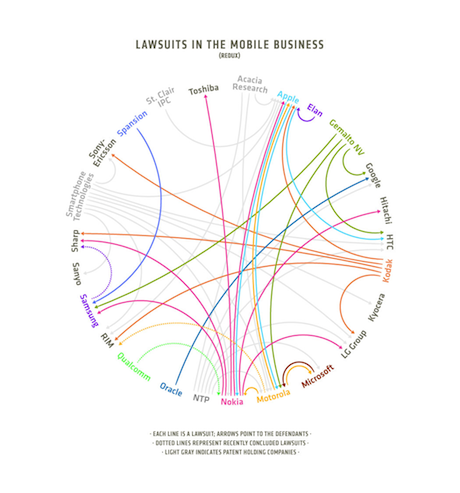
The complaint means that Google and its Android handset partners have a growing number of companies ranged against them as patent litigation has intensified over the past 18 months.
Apple is suing a number of Android partners, notably including Samsung and HTC, while Microsoft has extracted per-handset licence payments from HTC and Samsung, as well as similar Android-related payments from companies as diverse as Wistron, General Dynamics, Acer, Viewsonic, Itronix and Onkyo. By some calculations, Microsoft is getting more revenue from patent-related payments from Android than from its own Windows Phone operating system.
Google bought the Android handset maker Motorola Mobility in August , apparently to acquire its long-standing patent pool relating to mobile phones, after failing to acquire a patent pool from the bankruptcy sale of the Canadian company Nortel, which went to a consortium including Microsoft, RIM and Apple.
Gutierrez says the suggestion that certain features (such as an indication of how far a page has loaded) may seem obvious to people who don't understand how systems have to be built: "Many times when you express those ideas at a high level, they seem obvious to anyone who really doesn't understand the particular ways in which certain effects are achieved in software. It's not just one feature, but a whole series of features in a phone or another mobile device that really make up the whole experience of the user."
Gutierrez rebutted the suggestion in an interview with James Temple of the San Francisco Chronicle that the software giant has a campaign against Android. "Every time there are these technologies that are really disruptive, there are patent cases. People who lived in that particular time would look and say, 'What a mess, we certainly must live in the worst time from an [intellectual property] perspective. The system is broken and something has to be done to fix it,'" he said. "That's the situation we're in right now. If you think of a mobile phone or a tablet computer today, they're not your father's or your grandfather's cell phone."
He adds that different pathways to achieve the same ends would be independently patentable – which would imply that if a company can show that it uses a different method from the patented one to achieve an effect, it would have an absolute defence against a patent infringement suit.
In June, Microsoft lost a key software patent case which it had taken all the way to the Supreme Court, after it was sued by the Canadian company i4i over certain features of earlier versions of Office.
Google is facing a lawsuit from the database giant Oracle, which in 2009 bought Sun Microsystems and the rights to its Java code, over allegations that Android doesn't comply with the licence for Java.
Google's chief lawyer complained in July that software patents are "gumming up innovation"
The interview with Gutierrez is in two parts, here and here.

source

Tuesday, October 25, 2011

Google mulling part in Yahoo takeover scheme to edge out Microsoft

Internet giant might put money into takeover that would give it huge share of US search business

Google is considering providing the finance for the acquisition of Yahoo by another company or group of companies – potentially putting it into direct opposition in a bidding war with search engine rival Microsoft.
The shadow manoeuvring to bid for Yahoo, which fired Carol Bartz, its chief executive of just 18 months, in September is beginning to heat up as Microsoft and a number of private equity companies begin formulating their propositions for the struggling media company.
Google, with $42.6bn (£27.4bn) in cash, could afford to buy Yahoo, which has a market value presently of just over $20bn, but it unlikely to make a direct bid for it. There would be regulatory problems with the approach because if it were to take over Yahoo's search business then it would have a stranglehold on that sector in the US beyond its already dominant 65% share: Yahoo has about 15.5% of the sector in the US, with Microsoft's Bing (which powers Yahoo's search) at 14.7%.
Bloomberg News reported on Monday that Google's chiefs are still trying to decide whether to aid on one of the bids being cooked up.
A Google-backed takeover would ensure that Microsoft could not get control of the media company, which has been struggling with falling advertising revenue and share as rivals such as Facebook capture both attention and advertising. That, in turn, would mean that the Bing search engine which is presently a significant lossmaker for Microsoft would be unable to move into profit in the medium term, and could be shut out of a significant position in the desktop search market. Microsoft is trying to build Bing's share of the mobile search market through deals with Nokia and RIM, but with little impact so far.
Microsoft has recently been mentioned as a potential backer for a bid for Yahoo, in which it would provide a large chunk of the cash required for the bid, together with a number of other private equity companies. Yahoo's management has instructed Goldman Sachs to investigate potential scenarios to enhance the company's value - which could include a sale or going private.
Google is already under regulatory scrutiny from governments around the world. Greg Sterling, an analyst at Opus Research in San Francisco, told Bloomberg: "If competition dissipates or diminishes, then the hand of regulators is strengthened. If competition is diminished or marginalised, then all the arguments about Google being a monopoly ring more true."
In June the US Federal Trade Commission began a review of Google's business practices, including search and advertising. The European Union and the state of Texas also have begun investigations of the company's leadership in search and advertising markets.
Potential financing by Google for a bid for Yahoo has parallels with the $150m investment that Microsoft made in competitor Apple in 1997 to help preserve competition in the computer market, Sterling said.
But a Google bid would trigger regulatory interest. The US government threatened to challenge an earlier proposal by Google to place ads on Yahoo's site, causing Google to abandon the effort in 2008. At the time Microsoft was making a $44.8bn bid for Yahoo which ultimately proved fruitless.
Representatives of Yahoo and Google declined to comment.
The chief executive of China's Alibaba Group, whose largest shareholder is Yahoo, has also said his business is "very interested" in the Web portal, an arrangement that would help the Chinese company buy back its 43% stake.
KKR & Co. and Blackstone Group are among firms weighing an offer for Yahoo, people familiar with the matter said earlier this month. Alibaba has discussed a plan with Silver Lake and Russia's Digital Sky Technologies to make a joint bid, people familiar with the matter have said. Another group interested in an offer includes Providence Equity Partners and former News Corp. executive Peter Chernin, people have said. Google advertising customers are able to buy space on Yahoo sites through Google's Invite Media service, according to the person familiar with Google's deliberations.

Source

Friday, October 21, 2011

Microsoft revenues up but analysts question Windows strength

Strength of Office suite bolsters sales as slow PC growth and thinning margins leave analysts seeking next hit - though losses reduce at Bing search division

Microsoft posted record revenues up 11% to $17.37bn in its first fiscal quarter, but operating profits rose by just 1% to $7.2bn as its Windows, Server and Entertainment & Devices businesses showed slow growth. Those results were leavened by improvements in Microsoft's Office business.
Net income for the quarter to the end of September rose 6% to $5.7bn, compared to $5.4bn the year before.
Even though revenues at its Windows business rose to $4.87bn, up 1.7%, slightly below the 2% growth in shipments in the PC business excluding Apple, profits in the division fell by 1% to $3.25bn. The fall in profit reflects the problems the company faces with piracy in China and the Far East, which are the growth markets for PC sales - a point that chief executive Steve Ballmer has previously emphasised, saying that the company gets only 1/20 as much revenue from Windows PCs sold in China as it does in the US.
But the Redmond-based software giant saw strong growth in sales and profits at its Office business, where the 2010 package drove revenues up 7.7% to $5.6bn and profits up 5.7% to $3.7bn.
The overall results were in line with analysts' forecasts. Microsoft's shares, which have traded in the $20-$30 range for the last decade, fell 0.5% in after-hours trading, to $26.87. They closed at $27.04 on Nasdaq. "We still had Windows miss again, although not by nearly as much as it has the last couple quarters," said Brendan Barnicle, an analyst at Pacific Crest Securities. "They were just in line on EPS [earnings per share], which typically Microsoft beats," said Barnicle. "[Fiscal] first quarter is seasonally not a big quarter for Microsoft, and this was no exception."
The continuing weak point remains its Online Services division, which houses its Bing search engine. But that showed signs of improvement, with revenues up 18.6% to $625m - though still lower than in the previous three quarters - and the continuing losses significantly narrower, at $494m, compared to a $560m loss a year before. The Online Services division has not made a profit since the Christmas period of 2005, and Microsoft's interest in buying Yahoo is reckoned to stem from its desire to make its search alliance there pay. Even so, some analysts felt that it might have turned a corner, with the loss being its smallest for the past seven quarters.
Bing's US market share grew by 3.5 percentage points to reach 14.7% year over year, but Yahoo's share of search - which is driven by Bing - fell so that the companies' combined share was just 27%.
The Entertainment & Devices division, which includes the Xbox gaming console and the Windows Phone smartphone products, saw revenues grow 9.4% to $1.96bn although profits fell 8.8% to $352m.

Longer-term trends

The fall in the Windows division's profits point to longer-term shifts in the computer business as markets in the west slow down and China and the Far East become the new growth markets. Microsoft has seen the revenues and profits that it gets per Windows PC sold drop steadily even over the past four years, from per-PC payments above $60 at the end of 2007 towards $56 in the latest quarter, using the published figures from Microsoft and the calculations of PCs shipped from the research companies Gartner and IDC.
The profit per PC has also dropped substantially in the same period, from nearly $50 per PC to just just over $37 now, though in the previous quarter it was just over $32. The longer-term trend though means that Microsoft needs to find fresh ways to persuade people in the west to buy pricier PCs, or to encourage new growth trends.
That is clearly part of the drive behind its new Windows 8 "Metro" design, unveiled in September, which will be available in about a year's time and is intended to run both on standard desktop computers and also on tablet devices - where so far Microsoft has fallen well behind Apple's iPad and the many vendors offering tablets running Google's Android software.
Michael Yoshikami, chief executive of Ycmnet, said: "The numbers are not terribly unexpected. What is most critical is looking at the revenue transition from PC sales to alternatives. With the computer slowdown, the more the gaming becomes a bigger part of what they are doing, the more important it becomes to the business. I know they also swallowed Skype which impacted their financial results. I wouldn't call this quarter a disaster but it does underscore a company in transition. They realise they are in transition and they are trying their best to move into gaming and tablets and move into the cloud.
"Their old earnings line is going to get compressed. The Windows 8 announcement is interesting, but in a tough economy I'd be surprised if any companies step up to buy Windows 8, and it's in the upgrade where Microsoft makes money."
Trip Chowdhry, analyst at Global Equities Research, said: "A big question mark for Microsoft is what is the next multibillion [customer] problem that Microsoft is going to solve?" He suggested the stock won't go up until Microsoft identifies this problem.
"Coming up with the next version of an existing product is not a strategy," Chowdhry said. "Somehow Microsoft has failed to identify new markets both from a product perspective and business perspective. I don't think its stock can go up with the current product line they have. I don't think Windows 8 will propel the stock above $30."

source

Tuesday, October 18, 2011

Mango shows Microsoft still has the taste for smartphone success

The only worry is that Microsoft has delivered this lovely Windows operating system a little too late

Steve Jobs famously criticised Microsoft for having no taste and no culture. Windows Phone 7.5, the latest version of Microsoft's operating system for mobile phones, is a revolutionary product for its parent company because it has both in spades. The worry is that Microsoft has delivered this lovely creation a little too late.
As a piece of visual design, the operating system also known as Mango makes the iPhone's bubble-inspired home screen graphics look tired and out of date. The style is pared back, letting the content, drawn in from the myriad of online sources that now figure in our daily lives, do the talking. Applications each inhabit a simple red square, or "live tile" on a black screen. When customised they earn their name and truly come to life, which is where the culture comes in.
The level to which a select group of the best social media platforms – Facebook, Twitter, LinkedIn – have been woven into the functions on Mango goes well beyond what was available on its predecessor (Windows Phone 7), and arguably well beyond what Apple's iPhone and Google's Android can offer.
Punch in your Facebook and Twitter coordinates, and the software merges them with your address book to create a profile for each contact, with their latest photos, status updates and tweets. Pin that person's tile to your home screen, and each update feeds into the little square.
The most recent photos taken on your phone are also displayed in their own double sized tile. And the home screen can, unlike many other operating systems, display multiple tiles from a single application – one for each item you are bidding for on Ebay, or the weather in a handful of cities.
The messaging has caught up with iPhone. A conversation that might begin on Facebook chat but then moves to text messaging or Windows Live Messenger – the Microsoft instant messaging service – now appears on screen in a single thread.
Where the operating system does fail to impress is with voice recognition. Mango incorporates it, for example to compose an email. But "Want you meet camera" is not a very usable approximation of "Want to meet tomorrow".
Voice commands are not just a diverting new trick. They are the future for smartphones. Using virtual keypads on a tiny touch screen is life sapping, and impossible to do while walking. But the trusty buttons of a qwerty keyboard are just not sexy enough to be added to the iPhone. So Apple is doing its level best to get us using Siri, its own voice service, which has surprised users with its accuracy. Microsoft has some catching up to do here.
And it will make every effort to catch up. The software behemoth is not just fighting for a nice sideline, it is fighting for control of the mass market computer. As mobile connected devices become cleverer and are touched by millions more fingers than have ever typed on a PC keyboard, the importance of the laptop or desktop computer will fade and with it Microsoft's influence.
There is a long battle ahead. Research firm IDC says Windows operating systems were on just 2% of phones sold worldwide in the first half of this year, down from 13% in 2008. Back then, Android's share was 0%. In three years it has become the best seller, with 42%. BlackBerry is still significant, and Apple's iOS is at 19%.
The first Nokia handsets to use Windows will be unveiled in London next week. Nokia still sells more "feature" phones than anyone else, but it sold just 15% of smartphones in the summer, down from 33% in 2010. Its decision to abandon Symbian left it unable to compete for most of this year. The alliance with Microsoft is clearly make or break, and their target as they attempt to rise up the ranks will be Android.
Research In Motion, maker of BlackBerry, will continue to chase its corporate market. Apple will remain the premium brand for now. Which will leave Microsoft and Google slugging it out for dominance of the cheaper, mass market handsets.
Where Google may have the edge is control over handset design. It is buying Motorola, possibly just for the patents needed to protect Android against litigation, or possibly to create better phones. Nokia and Microsoft are merely in an alliance, but they have size, marketing firepower, relationships with networks and experience on their side. Nokia won its battle for dominance of the mass market against Motorola at the end of the 1990s, and still sells more basic feature phones than anyone else. Microsoft knows a lot more about selling operating systems than Google, albeit on PCs. Its creator may be a fading force, but Mango shows Microsoft still has the taste for success.

source

Friday, September 30, 2011

Guess who generates more revenue, Apple or Microsoft?

Apologies to readers who complain that I lean too heavily on the work of Asymco's Horace Dediu, but this one was too good to resist.
As promised on his Critical Path podcast Wednesday, Dediu has begun comparing Apple (AAPL) in a systematic way to some of its peers, starting with Microsoft (MSFT). On Thursday he posted a pair of charts tracking Microsoft's revenue streams by segment and Apple's revenues by product over the past four years. He stacked the charts one on top of the other, but because they use the same horizontal and vertical scales, they can also be shown side by side. (Click the charts above to enlarge them.)
Seen this way, several facts jump out. To name just two:
  • Apple gets more revenue from the Mac than Microsoft gets from Windows
  • Apple's iOS devices generate more revenue that all of Microsoft's products put together
For the rest of Dediu's findings, click here.

source