Figures from Kantar ComTech show how dramatically Android has risen to prominence - but what does that mean for rival contenders such as Nokia, Apple and RIM?
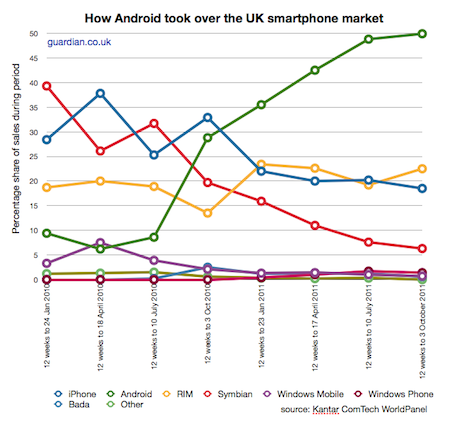
In just 18 months, Android has come from nowhere to become the mobile OS powering just under half of all smartphones sold in the UK – and half the people owning a mobile phone in the UK have a smartphone.
In the process it has bested Nokia's Symbian (since declared dead, though still stumbling to its grave), RIM's BlackBerry OS (which is fighting back) and Apple's iPhone (which, given its comparatively high price until the latest cuts to the iPhone 3GS and iPhone 4, was never likely to dominate long-term).
It's an amazing run for Android which is likely to carry on into 2012, since it's taken four years to reach this point (longer if you count Nokia's, RIM's and Microsoft's offerings from 2005/6 as smartphones) but the number of smartphones being sold is accelerating.
What these figures don't show you is that the entire market is growing; Kantar ComTech WorldPanel, which provides the statistics, declined to give absolute sales figures (they want to have something to tempt clients to buy the full reports). A minor note: these figures go up to 2 October, just before the iPhone 4S launch; expect that Apple's share will recover slightly. Even so, Android is just going to keep growing.
It's very likely that in the next two years you'll see smartphones reach something like 90% penetration in the UK - if only because fewer shops and carriers will be selling feature phones, for two reasons: (a) they make less money selling them in the first place (b) carriers get less money from phones that don't have data plans.
Android is almost certain to sweep the board here: it could hit up to 70% market share in one or two years (remember, market share is "share of handsets being sold", not "share of handsets in peoples' hands"). That's because Android handsets from cheaper manufacturers such as China's Huawei and ZTE will come in at the bottom of the market (it's noticeable how the "Other" segment has fallen to zero in the past year). Pretty soon you're going to be able to get a smartphone for almost nothing in your local supermarket. And you can already get really cheap PAYG data options from Three or GiffGaff.
For the record, I think it's great that smartphones are becoming pervasive. Putting the internet in everyone's hands, wherever they are? (If only the mobile carriers would stop holding up the 4G auction.) That's got to be a really good thing.
Does it matter, though, whether the pervasive OS is Android, or what share this or that OS has, beyond the willy-waving horse race that some people love to indulge in? Here's Henry Blodget over at BusinessInsider, who slams on the CAPS LOCK to pronounce ATTENTION APPLE FANS: Samsung Blowing Past Apple To Become The Biggest Smartphone Vendor Is Not Good News". (By which he means not good news for Apple. Though by implication, it would also be Not Good News for RIM and Nokia either.)
Blodget's take:
Now to the first point, about "the history of the tech industry". Actually, the history of the tech industry is a wide and varied thing, which doesn't show any clear lessons about dominant platforms. Yes, you do get dominant platforms, but that doesn't prevent other players existing within niches and making good money from it. Cite 1: Apple, making nice money, thanks, from the PC market. Cite 2: Microsoft, making nice money, thanks, from the server OS market, despite Linux being the most-used. The leverage of Apple and Microsoft in those respective spaces is helped by the existence of standards, and it's those - plus the internet - which make the "platform" idea less powerful on smartphones.
Think of it like this: if the PC market had started when the internet was already pervasive, then operating systems would have had to have internet standards built in; that would have forced more interoperability. It was the threat that Netscape might force interoperability on all computing platforms that scared the bejeezus out of Microsoft in the 1990s. So smartphones, which are arriving when the internet is pervasive, will live by different standards.
Horace Dediu, who runs the consultancy Asymco, puts it like this: imagine a world where 5 billion people have a smartphone. In that case, a 10% share translates to 500 million users. Even a 1% share is 50 million. If you couldn't make a profit from 50 million users, you probably shouldn't be in the business at all.
And just a side note on that "wildly profitable" Google search from their phones. All the web stats, and Google's own stats, indicate that - for now anyway - about two-thirds or more of mobile web browsing and searching is mostly done by iOS users (iPhone, iPod Touch, iPad). In some places it's much higher. Now, past performance is not necessarily a guide to the future (you only have to look at the graph to see that). But you have to ask too: what exactly is the "network effect" that Blodget thinks Google will get from Android? People writing apps? They already do; but it hasn't dented the bigger platforms.
The interesting challenge will be for Nokia and RIM, which have to establish themselves at the higher end of the market as everything shifts to smartphones. But in a growing market, the only problem is how to supply enough people. Android's a whopping success. But that doesn't shut anyone out - yet.
source
In just 18 months, Android has come from nowhere to become the mobile OS powering just under half of all smartphones sold in the UK – and half the people owning a mobile phone in the UK have a smartphone.
In the process it has bested Nokia's Symbian (since declared dead, though still stumbling to its grave), RIM's BlackBerry OS (which is fighting back) and Apple's iPhone (which, given its comparatively high price until the latest cuts to the iPhone 3GS and iPhone 4, was never likely to dominate long-term).
It's an amazing run for Android which is likely to carry on into 2012, since it's taken four years to reach this point (longer if you count Nokia's, RIM's and Microsoft's offerings from 2005/6 as smartphones) but the number of smartphones being sold is accelerating.
What these figures don't show you is that the entire market is growing; Kantar ComTech WorldPanel, which provides the statistics, declined to give absolute sales figures (they want to have something to tempt clients to buy the full reports). A minor note: these figures go up to 2 October, just before the iPhone 4S launch; expect that Apple's share will recover slightly. Even so, Android is just going to keep growing.
It's very likely that in the next two years you'll see smartphones reach something like 90% penetration in the UK - if only because fewer shops and carriers will be selling feature phones, for two reasons: (a) they make less money selling them in the first place (b) carriers get less money from phones that don't have data plans.
Android is almost certain to sweep the board here: it could hit up to 70% market share in one or two years (remember, market share is "share of handsets being sold", not "share of handsets in peoples' hands"). That's because Android handsets from cheaper manufacturers such as China's Huawei and ZTE will come in at the bottom of the market (it's noticeable how the "Other" segment has fallen to zero in the past year). Pretty soon you're going to be able to get a smartphone for almost nothing in your local supermarket. And you can already get really cheap PAYG data options from Three or GiffGaff.
For the record, I think it's great that smartphones are becoming pervasive. Putting the internet in everyone's hands, wherever they are? (If only the mobile carriers would stop holding up the 4G auction.) That's got to be a really good thing.
Does it matter, though, whether the pervasive OS is Android, or what share this or that OS has, beyond the willy-waving horse race that some people love to indulge in? Here's Henry Blodget over at BusinessInsider, who slams on the CAPS LOCK to pronounce ATTENTION APPLE FANS: Samsung Blowing Past Apple To Become The Biggest Smartphone Vendor Is Not Good News". (By which he means not good news for Apple. Though by implication, it would also be Not Good News for RIM and Nokia either.)
Blodget's take:
As the history of the tech industry has demonstrated again and again, technology platform markets tend to standardize around a single dominant platform. Although several different platforms can co-exist while a market is developing, eventually a clear leader emerges. And as it does, the leader's power and "network effects" grow, while the leverage of the smaller platforms diminishes.
In the case of Android, this growing power will not lead to enormous profits for Google, because, right now anyway, Google is not selling Android. (Instead, Google is building a "moat" around its wildly profitable search business and making it easier for people to use Google search from their phones. This may change when Google acquires Motorola and starts selling integrated handsets itself.)
But the better Android phones get, and the more market share Android gains, the more Android's network effects will increase, and the more Apple's leverage over the iPhone ecosystem will diminish. And that can only be bad news for Apple's ability to continue to command exploding profits from iPhones, app developers, musicians, media companies, and others who now must pay it big distribution fees because they have no other choice.There's three things there. Let's take the last one first: supply chains. Apple didn't do badly in 2007 when it was an entrant to the mobile phone supply chain, and it's got enough money in the bank that it can guarantee supplies any time it likes. (That's what it uses its cash reserves outside the US to do: buy up future outputs from various factories.) Most smartphone manufacturers don't have much scale; that's unlikely to change. Samsung is likely to get bigger (though it would be helpful if it would be more forthcoming about how many phones and how many tablets it has pushed out the door). That won't stop Apple making phones, though. And by proxy, it won't stop RIM or Nokia making phones - Nokia is still the world's largest in handset volume. Only mismanagement can mess that up.
Similarly, the bigger other global handset manufacturers get relative to Apple, the less (relative) leverage Apple will have over partners in the global parts-and-manufacturing supply chains.
Now to the first point, about "the history of the tech industry". Actually, the history of the tech industry is a wide and varied thing, which doesn't show any clear lessons about dominant platforms. Yes, you do get dominant platforms, but that doesn't prevent other players existing within niches and making good money from it. Cite 1: Apple, making nice money, thanks, from the PC market. Cite 2: Microsoft, making nice money, thanks, from the server OS market, despite Linux being the most-used. The leverage of Apple and Microsoft in those respective spaces is helped by the existence of standards, and it's those - plus the internet - which make the "platform" idea less powerful on smartphones.
Think of it like this: if the PC market had started when the internet was already pervasive, then operating systems would have had to have internet standards built in; that would have forced more interoperability. It was the threat that Netscape might force interoperability on all computing platforms that scared the bejeezus out of Microsoft in the 1990s. So smartphones, which are arriving when the internet is pervasive, will live by different standards.
Horace Dediu, who runs the consultancy Asymco, puts it like this: imagine a world where 5 billion people have a smartphone. In that case, a 10% share translates to 500 million users. Even a 1% share is 50 million. If you couldn't make a profit from 50 million users, you probably shouldn't be in the business at all.
And just a side note on that "wildly profitable" Google search from their phones. All the web stats, and Google's own stats, indicate that - for now anyway - about two-thirds or more of mobile web browsing and searching is mostly done by iOS users (iPhone, iPod Touch, iPad). In some places it's much higher. Now, past performance is not necessarily a guide to the future (you only have to look at the graph to see that). But you have to ask too: what exactly is the "network effect" that Blodget thinks Google will get from Android? People writing apps? They already do; but it hasn't dented the bigger platforms.
The interesting challenge will be for Nokia and RIM, which have to establish themselves at the higher end of the market as everything shifts to smartphones. But in a growing market, the only problem is how to supply enough people. Android's a whopping success. But that doesn't shut anyone out - yet.
source